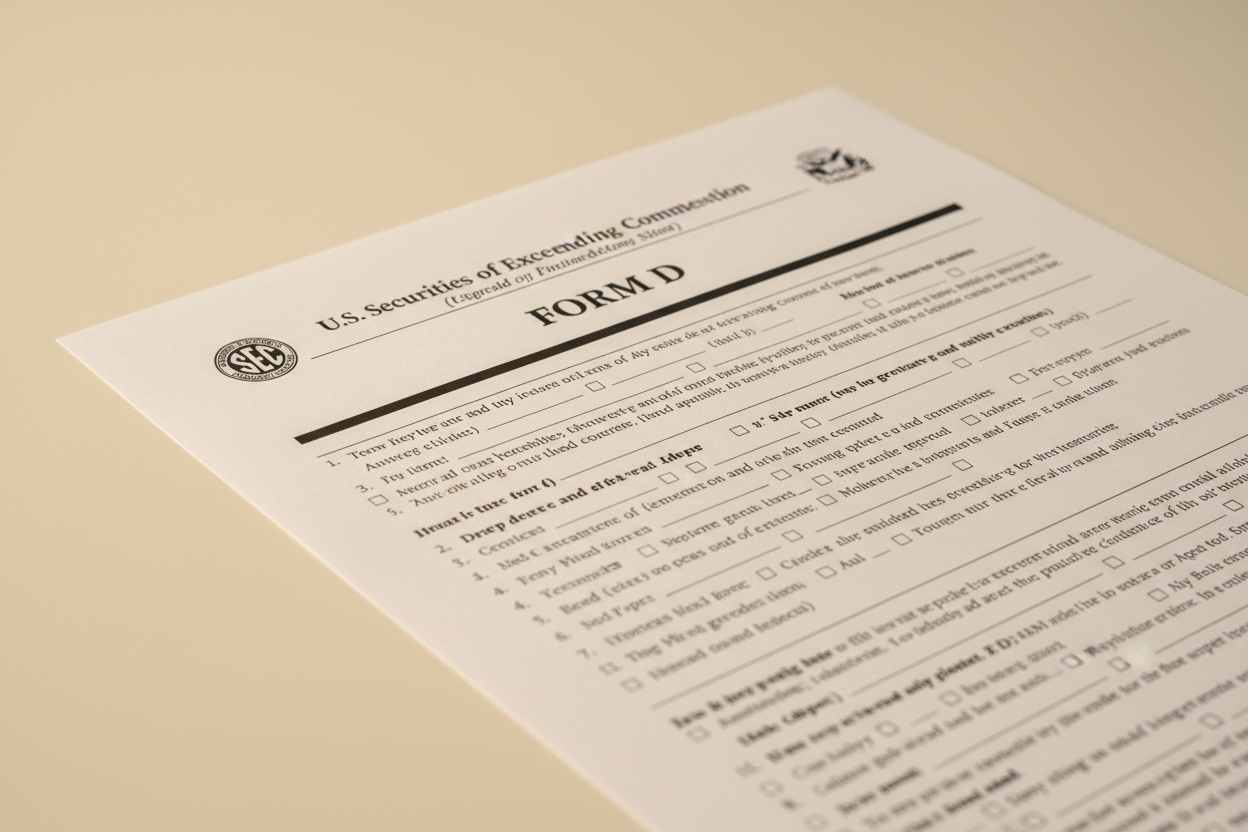
Every private funding round in the US is a legal filing. Not an announcement, not a press release: a document required by federal securities law, submitted to the SEC, and published on a government database that anyone can search. That document is Form D.
Most people in sales and recruiting have never looked at it. The ones who have tend not to tell their competitors.
The legal basis
The Securities Act of 1933 requires companies to register securities offerings with the SEC before selling them to investors. Full registration is expensive, slow, and designed for public companies. Private companies use exemptions instead.
Regulation D is the most widely used exemption. It lets private companies raise from investors without a full public registration, in exchange for filing a short disclosure form with the SEC within 15 days of the first sale of securities.
That obligation applies at every stage: angel checks, pre-seed rounds, seed rounds, Series A through D and beyond, bridge notes, convertible notes, and SAFE agreements that include a securities component. If a US private company accepted investor money under Reg D, they filed a Form D.
Who files
Form D is not only for tech startups. Any US private company raising under Regulation D must file. In practice, that includes:
- Early-stage software companies raising seed rounds
- Growth-stage companies raising Series A through D
- Real estate funds and private equity vehicles
- SPVs (special purpose vehicles) set up around a specific investment
- Hedge funds and private credit funds
- Healthcare companies, biotech, manufacturing startups
The SEC processes roughly 20,000 to 30,000 new Form D filings per year. The majority are fund vehicles, not operating companies. Filtering to operating companies raising equity requires a few additional signals: the federal exemption type, the industry classification, and the revenue range.
What a Form D contains
The form has eleven numbered items. Here is what the useful ones contain:
- Issuer information (Items 1-2). Company name, legal entity type, state of incorporation, registered address, and phone number. The address is often a registered agent in Delaware, not a physical office.
- Related persons (Item 3). Names and titles of directors, executive officers, or promoters associated with the offering. Usually the CEO, CFO, or both. These are the people most sales reps, journalists, and recruiters need.
- Industry group (Item 4). A sector classification from the SEC's 13-category list: Technology, Healthcare, Finance, Real Estate, and others. Self-reported and coarse, but useful for filtering at scale.
- Issuer size (Item 5). Revenue or net asset value, reported in wide bands: No Revenues, $1M-$5M, $5M-$25M, up to $1B or more. Early-stage companies without revenue select “No Revenues.”
- Federal exemption type (Item 6). Rule 506(b) or Rule 506(c). The distinction determines whether the company publicly solicited investors. Most operating companies use 506(b). Many fund vehicles and investor syndicates use 506(c).
- Offering and sales amounts (Item 7). Total offering size, amount already sold, and the date of first sale. The date of first sale is the funding date, not the announcement date.
- Number of investors (Item 11). The count of investors who have already purchased. Not their names, not their firms: only the headcount.
What the form does not include: investor names, the company website, any product description, deal terms, or valuation.
The 15-day window
Companies must file within 15 days of the first sale. In practice, most file within 3 to 12 days. That one constraint is what makes Form D useful as an intelligence signal.
A startup closing a seed round typically keeps the news internal for 2 to 6 weeks before issuing a press release, updating Crunchbase, or posting on LinkedIn. They are onboarding investors, hiring, and setting strategy. Public announcement comes later.
The Form D, by law, comes first. The gap between the EDGAR filing date and the first press mention of a round is typically 10 to 15 days for seed rounds. For Series A and later, it often runs 30 days or more. Some rounds are never publicly announced at all. Every one of them still has a Form D.
That window matters. A company in the first 30 days after close is actively setting its stack, its vendor list, and its priorities. A rep who shows up during that window looks well-informed. A rep who shows up after TechCrunch covers the round is competing with every other rep who got the same Google alert.
506(b) versus 506(c)
Regulation D has two primary rules. Understanding the difference tells you what kind of company you are looking at.
Rule 506(b) is the standard option. The company raises from up to 35 non-accredited investors and an unlimited number of accredited investors. No advertising or general solicitation is permitted. Institutional seed rounds, Series A through D, and most venture-backed companies use 506(b).
Rule 506(c) allows general solicitation, meaning the company can advertise the offering publicly. All purchasers must be verified accredited investors. Hedge funds, real estate syndicators, and investor-facing campaigns tend to use 506(c).
For most prospecting use cases, 506(b) filings are the primary target. They represent operating companies that raised from investors who already knew them, without public advertising. 506(c) filings skew toward fund vehicles and investment vehicles, not product companies in a buying window.
What Form D does not tell you
The filing is required disclosure, not a press release. Its limits are worth understanding before building a workflow around it.
No investor names.Item 11 gives you a headcount. It does not name the firms or angels. For lead investor identification, you need supplementary sources: the company's website, LinkedIn announcement, or press coverage if it exists.
Registered addresses, not real offices. Delaware-incorporated companies routinely list a Wilmington registered agent address. The actual team is somewhere else.
Amendments are not new rounds.When an offering is still open and taking on additional investors, the company files a Form D amendment with an updated “total amount sold.” An amendment does not mean a new funding event. The date of first sale in Item 7 tells you when the round actually started.
The industry code is approximate.A B2B SaaS company and a blockchain protocol might both select “Technology.” The code narrows the field at scale, but it does not replace company-level research.
Where to find Form D filings
The SEC publishes all Form D filings on EDGAR (the Electronic Data Gathering, Analysis, and Retrieval system). The full-text search interface at efts.sec.gov lets you filter by date range and company name. The raw filings are in XML format.
The manual workflow: search EDGAR for filings from the past 7 days, download the XML, parse the relevant fields, filter by sector or state, and pull executive names for outreach. Most people who try it once spend three hours on it and move on.
FlareSight indexes every Form D the day it lands on EDGAR. Each company is enriched with founder contacts, funding history, website, and sector classification. The filing arrives; the company appears in the database within 24 hours. The search, filtering, and contact enrichment that would take a rep half a day takes about 20 minutes.
If you want to understand what the data looks like in practice, the next step is seeing a live filing alongside the secondary signals it precedes. The companies in the FlareSight database are sorted by filing date. The most recently filed are at the top. Most of them have not been announced yet.
Last updated: 2026-05-17
Founder of FlareSight
Builder of FlareSight, the SEC Form D startup database. Indexes 120,000+ US companies within 24 hours of filing.
Related reading
See today's Form D filings
FlareSight indexes every filing within 24 hours of it landing on EDGAR, enriched with founder contacts and funding history.
Browse recently funded startups free →